Nemeio Puts a Keyboard Over an ePaper Screen for Maximum Customization and Flexibility

Peripherals startup Nemeio has launched a crowdfunding campaign for a keyboard with a difference: Each key is a configurable ePaper display, allowing for unlimited customization.

“Nemeio is completely customizable because of its built-in wide ePaper screen,” explains project founder Laurent Villemonte de la Clergerie. “Whether you choose an existing keyboard layout or design your own, Nemeio will display your own personalized keyboard – just the way you like it!”

Read more…

This Breadboard Wristwatch Is Delightfully Geeky

Wristwatch use today is more about making a fashion statement then any real need to tell the time, considering we’re surrounded by clocks and everyone has a smartphone on their person at all times. Mobsters and car salesmen make that statement with gold Rolexes, Ivy League types prefer diving watches made by unpronounceable Swiss brands, and hipsters like to wear old Casio watches ironically. Geeks, however, prefer LEDs and display readouts that are indecipherable to anyone who doesn’t understand binary. Unfortunately, binary wristwatches are a bit played out these days, which is why Inge took a different approach to geek fashion and built a breadboard wristwatch.

Read more…

New Flexible Battery Is 10 Times More Powerful Than Standard Lithium Batteries

More powerful and easier to manufacture than commercial standards, this battery is ideal for wearables and soft robotics.

A team made up of researchers from the University of California San Diego and California-based company ZPower recently developed a flexible, rechargeable silver oxide-zinc battery with a five to 10 times greater areal energy density than standard batteries. Not only does it perform better than most commercial flexible batteries, but it’s also easy to manufacture. Most flexible batteries require sterile conditions, under vacuum for manufacturing. This new battery can be printed in normal lab conditions, making it ideal for use in electronic wearables and soft robotics.

This battery’s areal capacity is 50 milliamps per square centimeter at room temperature, which is 10 to 20 times greater than the areal capacity of your standard Lithium-ion battery. Due to its lower impedance or the resistance of an electric circuit or device to alternative current, the battery has a higher capacity than current flexible batteries.

Read more…

Using an Intel NUC to Build a Miniature iMac G4 “Lamp” That Actually Runs macOS

Apple has put out some unusual designs over the years, starting with the original Macintosh — the Apple II was fairly conventional in appearance — and carrying on all the way up to the current “cheese grater” Mac Pro. But few of them stood out on store shelves as much as the iMac G4. It was released in 2002 and had an LCD, which was unusual for the time, attached to the top of a dome that housed the rest of the components. The design was most often compared to a Pixar-style lamp, and is remembered fondly by enthusiasts today. GregO29 managed to replicate the iMac G4 in miniature form using an Intel NUC.

Read more…

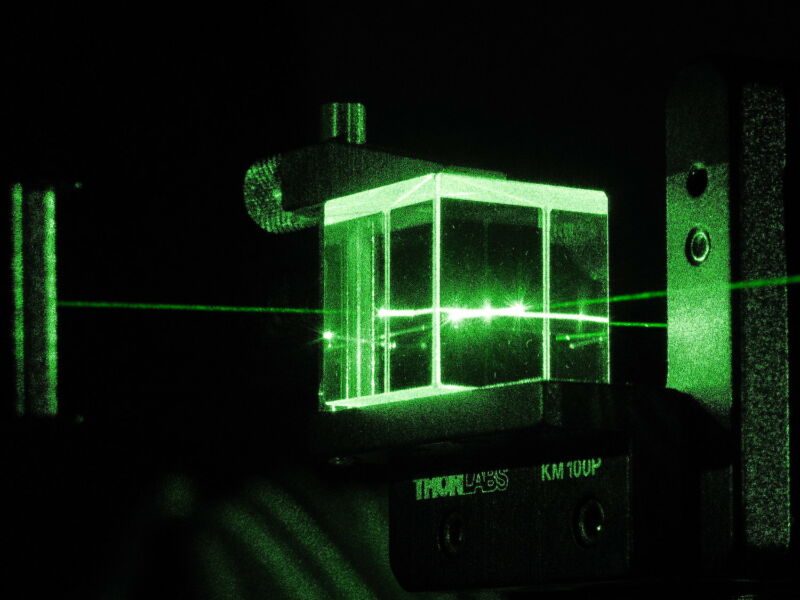
Quantum device performs 2.6 billion years of computation in 4 minutes

Photons explore quantum maze faster than possible for any classical computer.

I am a great believer in solving problems with lasers. Are you suffering from a severely polarized society and a fast-growing population living below the poverty line? Well, I have the laser to solve all your problems.

OK, maybe not. But when it comes to quantum computing, I believe that lasers are the future. I suspect that the current architectures are akin to the Colossus or the ENIAC: they are breakthroughs in their own right, but they are not the future. My admittedly biased opinion is that the future is optical. A new paper provides my opinion some support, demonstrating solutions to a mind-boggling 1030 problem space using a quantum optical system. Unfortunately, the support is a little more limited than I’d like, as it is a rather limited breakthrough.

Read more…

Simple External and Internal Weather Station using Arduino Nano, DHT22, 433Mhz

Today I would like to propose a simple project that requires easy skills. It’s a simple weather station, that measures, internal and external temperature. It’s made out of two components: an indoor receiver, and an outdoor transmitter. The transmission is managed at 433Mhz. The components and the electrical diagram for both devices, are showed in the video. The receiver is very easy to use. to toggle between the external and internal temperature, you need to press the button for more than 3 seconds.

Making a STAR WARS Table from Concrete & Epoxy Resin

This episode shows how to make a DIY Star Wars-inspired coffee table from concrete, wood, epoxy resin, and LED strips.

I combined Death Star style lighting with GFRC concrete, woodworking, and epoxy resin that is backlit with LEDs to make this Star Wars inspired coffee table. My goal was to design a DIY concrete and epoxy coffee table that every Star Wars fan would recognize as being inspired by Star Wars, but that non-Star Wars fans would just see as a cool table design.

DIY Color Changing Acrylic Nightlight using ATtiny85 Microcontroller and Arduino

In this video I create a color changing nightlight based on a famous symbol from one of my son’s favorite video games. Because space was tight, I decided to use an ATtiny microcontroller instead of an Arduino. These are very inexpensive and are a great way to shrinkify your Arduino projects. ATtiny come in multiple configurations (number of pins and amount of memory). One of the most popular is the ATtiny85 which only has 8 pins and is very small.