
How about a Spider who obeys the order to sit, dances when he sees a light and dodges obstacles? All of this was assembled with just one board, the Arduino Nano 33 BLE Sense.
External News
Spying Robot Vacuums Really Suck
LidarPhone exploits the LiDAR sensor in robotic vacuums to eavesdrop on your private conversations.
Just when you thought you had all your bases covered for privacy, it turns out that even your seemingly innocent robot vacuum may be spying on you. And all this time you thought it was only collecting dirt from the floor.
A team in Singapore took advantage of the LiDAR sensor typically found onboard robotic vacuums for navigation purposes, and repurposed it to capture sound with an exploit that they call LidarPhone. Laser microphones, in which laser beams reflected off of vibrating objects are converted into audio, are not a new idea. However, laser microphones require sophisticated setups and fine-tuning that is not possible with a stock vacuum cleaner. Getting a vacuum to work as a laser microphone took some clever thinking.
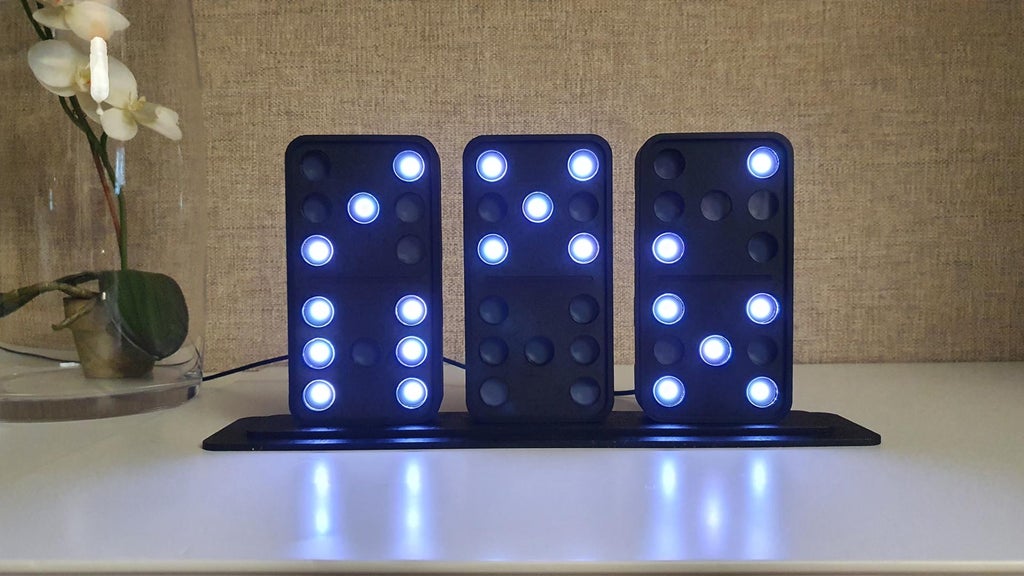
This DIY domino clock tells the time using three LED-lit tiles
After coming across Carbon Design Group’s Domino Wall Clock, which uses electronic magnetic coil motors to reveal white dots, Instructables member “Kothe” decided to create a simplified version of their own.
The clock is comprised of three custom dominoes — the first tile for hours, the second and third for minutes. Unlike its inspiration, Kothe’s device uses addressable RGB LEDs as dots that allow for a variety of colors to shine through.
Switch Bouncing Effect and Debouncing Circuit
In this video, the switch bouncing effect is explained in details and the ways of coming over it using hardware and software solutions. Switch debouncing circuit is discussed and explained experimentally.
PiWatcher TB Is a Raspberry Pi Watchdog
3
A well-worth-the-buy Raspberry Pi peripheral device is now available on Tindie, Omzlo’s PiWatcher TB, a small board made to automatically shut down or reboot your Pi when needed. Useful in case of incident or just for power saving purposes, the board can even be programmed to shut an Pi down and automatically reboot it a set amount of time later, whether that means a few minutes or a few hours.
Simply put, the PiWatcher TB is a watchdog circuit for the Raspberry Pi. It is a variation on Omzlo’s classic PiWatcher also available on Tindie. It is designed to solve two problems with regard to power management on Pis: wasteful power usage due to incomplete shutdown following a shutdown or halt command and recovery from situations in which the Pi has become stuck in an unrecoverable state. For the first, the watchdog circuit can be configured to fully cut power following a shutdown command. For the second, it can be programmed to power cycle should it not read a heartbeat from the device after a set period of time.
CadetPedals Demonstration and Build
Thingiverse Files: https://www.thingiverse.com/thing:465…
Arduino Project (Build Information, BOM, and reference pictures in ReadMe): https://create.arduino.cc/editor/vinc…
Andy Geppert’s Core 64 Interactive Core Memory Boards Get a Final Design and 3D-Printed Weaving Jig
Designed to bring back a classic from the early days of computing in interactive form, the new Core 64 boards will form a stack eight deep.
Andy Geppert has unveiled the latest entry in the Core 64 family, a range of badge boards designed to bring back a classic of early computing: hand-woven magnetic core memory.
While modern computers and microcontrollers run from dynamic RAM, static RAM, flash RAM, or most commonly a combination thereof, that technology wasn’t always available. Early computers had to rely on other forms of random access memory, with one of the most widespread being magnetic core — toroidal magnets suspending in a hand-woven grid of copper wire.
Playing the “Dinosaur Run Game” on an ATtiny10 Without Batteries
Jump and dodge obstacles on this keychain-sized PCB game console!
It has happened to almost all of us: suddenly going offline while using Chrome and having that dinosaur run game pop up. This is what inspired this project’s creator, ridoluc, to develop a much smaller implementation of the game. What he was able to come up with can fit in a 34 x 25mm area and run indefinitely without the need for a battery.
These DIY Smart Glasses Provide Turn-By-Turn GPS Navigation Instructions
If you’ve ever walked into a telephone pole while staring at your phone’s map app, then Sam March’s DIY smart glasses are for you.
I think it’s fair to say that none of us know where we’re going anymore. Thanks to the proliferation of GPS technology, we no longer have to memorize the streets and layout of our city. That’s not necessarily a bad thing when you’re just driving around, but it is less than ideal when you’re walking. Aside from the potential danger of strolling into a light post, oncoming traffic, or an open manhole, staring at your phone while you walk prevents you from enjoying the sights your city has to offer. That’s why Sam March designed DIY smart glasses that unobtrusively provide turn-by-turn GPS navigation instructions.
Easy & Powerful Arduino Alternative? #4 Pyboard (MicroPython) Beginner’s Guide
In this video we will be having a closer look at the Pyboard in order to find out whether it is a good Arduino alternative. Along the way we will discover all of the features the board comes with and learn quite a bit of MicroPython programming. Let’s get started!