
Required elements:
1 x ultrasonic sensor
1 x Servo Motor
1 x buzzer
2 x led (green, red)
2 x 220 Ohm resistor
1 x 840 pin breadboard
Some jumper cables
External News
Ivan Miranda’s Sand Drawing Robot, Take 2
Drawing messages on the sand is perhaps as old as history itself, but Ivan Miranda has come up with a tracked vehicle to automate this ephemeral art form. In fact, what’s seen in the video below is his second take on a sand drawing robot, boasting a much faster print speed than his 2018 version with the caveat that it prints with less contrast.
The new device features 50 SG90 micro servos spread out across a piece of square tubing, controlled by a total of three Arduino Mega boards. These intermittently extend as they’re pulled forward by a tread system on each side to produce words. The build is so long that he has to actually extend his workbench to get it to fit, and at a weight of 13.5 kilograms (around 30 pounds) without the battery, he created a custom trailer assembly to walk it to the beach.
How transistor works : Explained | Electronics for beginners
A transistor is a semiconductor device used to amplify or switch electronic signals and electrical power. It is composed of semiconductor material usually with at least three terminals for connection to an external circuit. A voltage or current applied to one pair of the transistor’s terminals controls the current through another pair of terminals. Because the controlled (output) power can be higher than the controlling (input) power, a transistor can amplify a signal. Today, some transistors are packaged individually, but many more are found embedded in integrated circuits.
Cheap $30 USB Fighting Joystick / AliExpress
We check out the $30 cheapo on Aliexpress, and then go beyond the call of duty!
Works with PC, Pandora Games 3D, Pandora Box 9D, Pandora Box DX, Raspberry Pi
Building a Lego-powered Submarine 2.0 – magnetic couplings
This RC sub has magnetic couplings to transmit torque through the walls. No need to drill holes = no leaks. At the end I test it in a swimming pool. Enjoy!
Play Classic Atari, NES, and SMS Games with the ESP_8_Bit
This ESP32 emulator supports NTSC/PAL video out, and Bluetooth Classic an IR keyboards and joysticks.
There are a ton of projects that have used the Raspberry Pi, BeagleBone, and Arduino boards for gaming emulation, even in the form of handheld and tabletop systems. While they may be a dime a dozen, they are no less fun to build, especially if you are into retro gaming. Rossumur’s ESP_8_Bit is a minimalistic approach to retro 8-bit gaming and allows users to emulate three popular consoles, including the NES, Atari, and Sega Master System, complete with ROM selection menus.
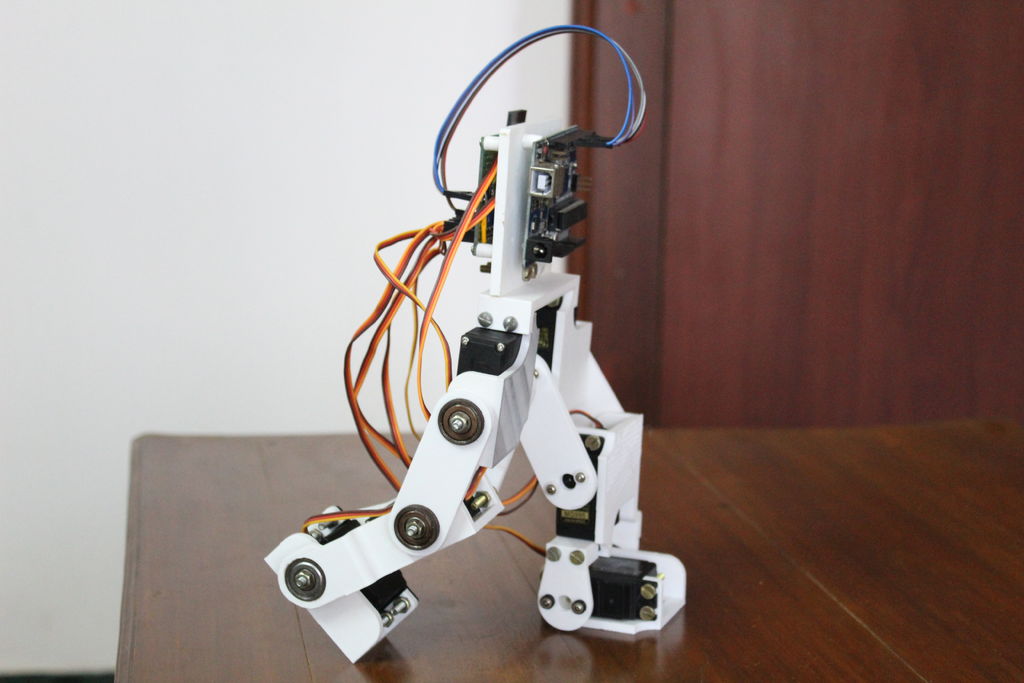
Building an Arduino-based bipedal bot
If you’d like to build a walking biped robot, this 3D-printed design by Technovation looks like a fantastic place to start. Each leg features three servos that actuate it at the hip, knee, and ankle for a total of six degrees of freedom.
Control is handled by an Arduino Uno board that rides on top of the legs, along with a perfboard to connect to the servos directly.
Samsung’s first 8TB SSD for mainstream PCs is the 870 QVO
Samsung finally has an 8TB solid-state drive that’s ready for the mainstream. The company has unveiled an 870 QVO range of SSDs that ranges from ‘just’ 1TB through to the flagship 8TB capacity — enough that you may not have to worry about free space for a long time. It’s an SATA drive limited to peak sequential read and write speeds of 560MB/s and 530MB/s respectively, but Samsung is promising a 13 percent boost in random read speeds over the 860 QVO.

Real-Time Voice Cloning (Toolbox)
This repository is an implementation of Transfer Learning from Speaker Verification to Multispeaker Text-To-Speech Synthesis (SV2TTS) with a vocoder that works in real-time. Feel free to check my thesis if you’re curious or if you’re looking for info I haven’t documented. Mostly I would recommend giving a quick look to the figures beyond the introduction.
SV2TTS is a three-stage deep learning framework that allows to create a numerical representation of a voice from a few seconds of audio, and to use it to condition a text-to-speech model trained to generalize to new voices.
After 20 years PlayStation 2 can play burned DVD’s without a modchip | MVG
FreeDVDExploit is a new hack for the Sony PlayStation 2 that has been discovered by Security Researcher CTurt – it allows the user to boot homebrew games on an unmodded PS2 console via DVD Player exploits. In this episode we take a closer look at how it works and what I think I means for the future of homebrew on the PS2.