Maz_Baz’s RaspberryPi-Powered, 3D-Printed Cyberdeck Gives the Rebel Alliance Pathfinders a New Tool

3D-printed chassis, inspired by Star Wars aesthetics, houses an off-the-shelf Raspberry Pi touchscreen, Bluetooth keyboard, and USB battery.

Redditor Maz_Baz has built a Raspberry Pi-powered cyberdeck that any Star Wars fan would love to lug around, inspired by the aesthetics of the Rebel Alliance Pathfinders and near-completely 3D-printed.

“Pathfinders are the special forces troops of the Rebel Alliance,” Baz explains of the inspiration behind the design, “and I wanted to create something that one of their techs might lug into battle — Field Terminal — for quick hacks into Imperial systems or airstrike coordination. Or in my case, a tactical way to go from my desk to my couch.”

Read more…

Simple Robots Can Work Together to Perform Complex Tasks

BOBbots can still accomplish a set of tasks, even without the aid of sensors, communication, and computation capabilities.

I love swarm bots of all types. Something so innocent about them. Researchers from Georgia Tech have developed a method that allows “simple” robots — those without sensors, onboard processing power, communication capabilities — to perform complex tasks by leveraging their physical characteristics, a trait they term “task embodiment.” Think of it like trying to control a child, which is hard enough, and then trying to control many of them at once, which is nearly impossible. The same can be said for trying to get swarms of robots to work collectively without complex programming and a ton of onboard sensors.

Read more…

Multiplexing 6 I2C TCS34725 Color Sensors

Have you ever had to use sensors that use the I2C protocol, but realize that they all have the same, non-changeable address?

While working on a project including multiple colors (which I hope to post soon), I realized I needed to use some sort of color sensor/camera. I decided to use 6 TCS34725 modules, which will be able to return the RGB values of certain colors to me. The problem was that these TCS34725 modules use the exact same address: 0x29! This was a problem for me since I needed 6 of these modules, and since the sensors all have the same address, it won’t know which ones which! This is when I realized I can use a multiplexer to get these sensor signals into one.

Read more…

Bluetooth Controlled LED Matrix

A hand-crafted 8×8 LED matrix driven on Arduino using the MCP23017 GPIO expander and controlled via Bluetooth from an Android device.

The internet is littered with tutorials teaching how to use dot matrices or build them, so why add-in another one I hear you say? Simply because making LED displays is fun, the outcome is eye-pleasing and useful in every way you could imagine. And since we’re at the age of IoT, what a better way to interact with it than from your smartphone. I used the LED matrix I built as a scrolling ticker, just to showcase the versatility of such a device. In the following I’ll shed some light on the essential building blocks of this project.

Read more…

This Little RaspberryPi Device Lets You View Your NFTs

Snarflakes designed a Raspberry Pi-based displayer that lets you view your NFT images whenever you like.

Non-fungible tokens (NFTs) are a new concept in the world of cryptocurrency, though the idea itself is timeless. A fungible currency or commodity is one that is identical in value to every other unit of its type. Conventional currency is fungible, because a particular dollar bill always has the same value as any other dollar bill. A non-fungible commodity’s value is dependent on its own unique characteristics. Diamonds, for example, vary in value depending on their size, clarity, inclusions, and so on. NFTs are units of currency with values specific to themselves, and they’re usually represented as images. This Raspberry Pi-based device lets you view those NFT images whenever you like.

Read more…

A Mini Bluetooth Dot Matrix Printer

This ATmega328P-powered device is like a tiny modern-day telegraph printer.

YouTuber Et Discover built a miniature printer that’s controlled by his phone over Bluetooth. The device uses a pen as the marking device and a micro servo and linkage system to move it back and forth. The small strip of paper is advanced by a 24BYJ-48 stepper motor, along with a ULN2003 driver, allowing for sequential control over pen placement.

What’s interesting from a mechanical standpoint is that the pen doesn’t descend to the paper to make each dot, but instead the rig employs an electromagnet to bounce the paper up to hit the pen. A neodymium magnet is embedded in the small printed platform that rises up to receive a dot, and a boost converter is used to produce 24 volts for actuation.

Read more…

Power Supply Uses Thin Form Factor

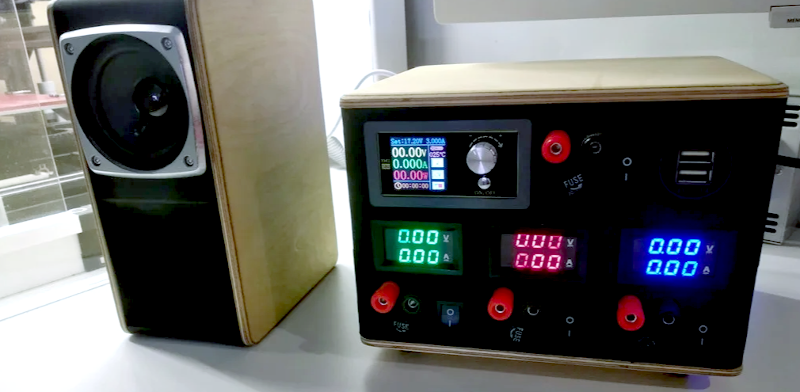
We’ve seen lots of power supply projects that start with an ATX PC power supply. Why not? They are cheap and readily available. Generally, they perform well and have a good deal of possible output. [Maco2229’s] design, though, looks a lot different. First, it is in a handsome 3D-printed enclosure. But besides that, it uses a TFX power supply — the kind of supply made for very small PCs as you’d find in a point of sale terminal or a set-top box.

Read more…

Thingiverse Files…

A DIY Stepper Motor Analyzer Designed for Your 3D Printers

This open source analyzer comes with an easy-to-use setup and tests each and every parameter of a stepper motor.

If you have a 3D printer and want to analyze the stepper motor signals without the use of a computer and expensive stepper analyzer, then this low-cost hardware design can solve your problem. The open source analyzer comes with an easy-to-use setup and can be easily built to give you the capabilities to test each and every parameter of the stepper motor.

Read more…